
Legacy & Modern Metal working Machinery
Your grandad's Hercus, installed in 1967, still runs like a Swiss watch. Your father's press brake from 1989 hums away honourably as the shop's metal fab workhorse. Then, one day – out of the blue, a repeat customer calls up and starts quizzing you about some precision parts he wants made, and whether your workshop can deliver ±0.01 mm specs.
For generations, Aussie family-run manufacturing businesses have reliably delivered for their customers, building their reputations on skill, hard work, and dependable equipment. But now, as precision standards reach unprecedented heights, even the most seasoned workshops are being asked to meet specs that once belonged only to the biggest or most specialised operations.
Today, the challenge isn’t capability; it’s keeping pace with shifting expectations, tighter tolerances, and greater complexity. The proud legacy remains; what’s changing is the nature of the demands. So, how do you honour that heritage while adapting to a world where precision is now the price of entry?
At Performatec, we know this journey intimately. As a family business ourselves, we've grown from machinery consumables, to advanced CNC cutting & folding machinery, walking the same path as so many of our customers: holding fast to what works, while opening our doors to what's next.
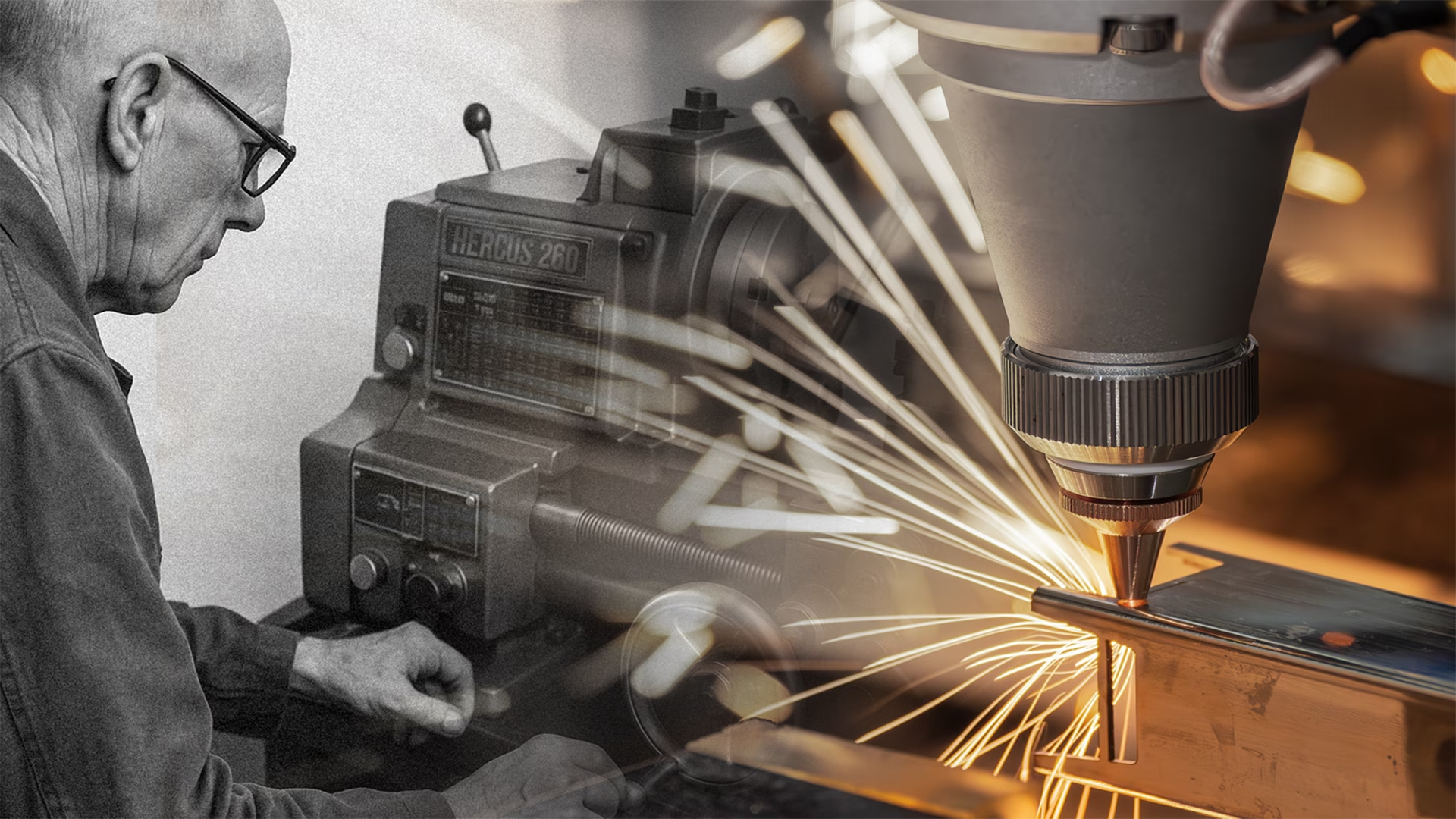

Modern Workshop Machinery
Often, the most significant barrier to upgrading workshop machinery isn't the budget; it's getting three generations to agree on change. Dad built the business using time-honoured, proven methods and prefers to keep the status quo. Junior is hungry for the latest technology. Grandpa wonders aloud if it's better to wait for Industry 5.0, still questioning why you'd fix something that isn't broken.
This generational divide is more common than you might think. Research shows that business leaders often encounter resistance to new technologies within family ties, but the tension runs deeper than equipment choices. It's about managing family dynamics, respecting a proud legacy, and making sure the business thrives for the next era.
Every generation brings valuable strengths to the table. Dad's proven methods have built a rock-solid foundation. Junior's enthusiasm for technology opens doors to new possibilities. Grandpa's steady caution helps to protect against unnecessary risks. Therefore, the real challenge isn't deciding who's right, it's finding a way forward that honours hard-earned experience, while embracing new ideas where they matter most.
Ultimately, the family businesses that succeed past the second generation are the ones that bridge these divides, focusing on shared goals rather than competing mindsets. They keep what works, improve what doesn't, and make deliberate moves for the future. Lasting success rarely comes from picking one perspective over another - instead, it comes from weaving all three together.
Family businesses achieve lasting success by uniting the unique strengths of each generation to create progress that honours the past while embracing the future.
Handing The Baton Over To A New Generation
The real challenge of passing the baton to a new generation often emerges when you zoom out and look at the bigger picture. According to industry data, only 12% of family businesses make it to the third generation, and increasingly, it's those who embrace new technology that survive these critical crossroads.
This is where family dynamics intersect with technical reality. The issue is no longer simply about whether the next generation wants to continue the business; it's whether they can compete in a manufacturing landscape that demands a level of precision their predecessors never imagined, or planned for.
Back in 1967, Grandad's ±0.5 mm tolerance was considered leading-edge manufacturing. Today, anything wider than ±0.1 mm falls short for high-end work. For critical defence contracts like F-35 components, repeatability demands have tightened to ±0.025 mm or even stricter; a precision leap that's literally fifty times more demanding than what was once state-of-the-art.
At that level of precision, the conversation shifts from the best metalworking equipment to capability expansion. The workshop that served three generations of customers faces contracts it simply cannot fulfil without wholesale technology adoption. As such, the generational handover becomes not just a leadership transition, but a technical evolution that determines business survival.
The Imperative for Survival and Growth
Simply recognising the need for change is no longer enough. Proactive adaptation has become a non-negotiable survival strategy. With automation, digitalisation, and precision engineering setting new benchmarks, businesses that lag technologically are increasingly vulnerable to obsolescence, no matter how strong their legacy or reputation.
A reluctance to modernise can stem from a variety of causes, such as cost concerns, disruption fears, or cultural resistance. Yet, the pace of innovation in manufacturing means that legacy capabilities can quickly become bottlenecks. Technologies that once defined quality (like the specs achieved in previous generations) may now represent missed opportunities for new contracts or partnerships.
For instance, advancements such as real-time data analytics, smart manufacturing systems, and robotics are not merely tools for efficiency; they are gateways to entirely new markets and customer expectations. Companies embracing these technologies can achieve levels of precision, traceability, and scalability that transform their value proposition for critical sectors like defence, automotive, or energy.
Successful generational transitions hinge on the willingness not just to inherit a business, but to reinvent it. This approach demands a new mindset: one that actively seeks out emerging technologies, invests in up-skilling the workforce, and fosters a culture where continuous improvement is celebrated, not feared.
Fundamentally, the question facing family and independently owned manufacturing firms is no longer just 'Will you survive the handover?' but 'Will you seize the opportunity to lead?'
Companies that perpetually evolve; those that view every technological step as a means to deepen client trust, boost operational excellence, and differentiate from competitors are the ones that thrive beyond each generational milestone.
Generational handover in manufacturing now demands decisive investment in new technology; without it, even the strongest legacies risk becoming obsolete
Metal Fabrication Equipment Built With Old-School Values
As we've explored, today's manufacturing landscape demands levels of accuracy and reliability that once seemed unimaginable, especially in industries where even the slightest variation can make all the difference.
This new standard is evidenced in the latest wave of metal fabrication equipment available to Australian workshops. Take the Baykal range of fibre lasers, for example. The BLS-Pro series boasts X and Y axis accuracy down to ±0.01 mm, making the most exacting tolerances routine. Meanwhile, Flow's waterjet technology achieves ±0.025 mm repeatability on materials up to 600 mm thick. For many workshops still relying on older machines that stretch to reach ±0.1 mm, these advances represent a true leap forward in what's possible.
Those extraordinary capabilities are rooted in exceptional legacies. Baykal brings over seventy years of know-how, with European facilities spanning more than 70,000 square metres, 650 dedicated staff, and 80 specialist engineers. This depth of expertise is channelled into every precision component and advanced control system, defining practical readiness for Industry 4.0 and beyond.
Flow Waterjet, too, carries an enduring reputation for progress and reliability. With more than fifty years of continuous innovation at its U.S. facilities, Flow has become a world leader in waterjet cutting systems. Their commitment allows manufacturers to cut virtually any material with astonishing precision and minimal waste, keeping them at the forefront of engineering across generations.
For family-owned businesses, this level of capability means much more than simply keeping up. It's a way to pay tribute to decades of dedication, while embracing new opportunities with confidence. Choosing equipment with legacies like Baykal's and Flow's means your workshop isn't just meeting the tightest specifications or winning new contracts, it's building on a proud foundation, ready for the decades ahead.
No matter who's at the bench, it's the same family pride behind every job. The right equipment makes it possible to keep that tradition going, whatever the future brings.
Innovative Manufacturing Equipment
After two decades working alongside other Australian family businesses, one thing has always stood out to us: innovation. When chosen wisely, innovative manufacturing equipment extends a business's legacy rather than obscuring it.
It goes without saying that family businesses make every decision with the next generation in mind. This long-term thinking shapes all choices, from capital equipment to customer relationships. In fact, studies show that two out of three multi-generation family firms see themselves as custodians - protecting and renewing what their predecessors built.
That perspective is evident on the workshop floor. The trust and reputation established by earlier generations (through attention to quality and reliable delivery) remain the backbone of many businesses today and even though client specifications become more demanding, those same ethics must endure.
Modern manufacturing technology, like that of Baykal or Flow Waterjet, now enables manufacturers to safeguard long-standing traditions and keep earning repeat business no matter how standards, regulations, and industries evolve.
Australian Manufacturing Success
Workshop foundations to digital frontiers
Australia’s manufacturing legacy is defined by practical innovation. Progressing from noisy, fume and dust laden workshops, to today’s 'lights-out', IoT-enabled factories. Each generation has moved the sector forward, and for family-owned businesses, Industry 4.0 presents the greatest opportunity yet.
However, embracing new technology isn’t just about technical upgrades; it’s about preserving the values that set family enterprises apart. Many manufacturers worry digital adoption might dilute their hallmark craftsmanship and customer relationships. We believe, with the right strategy, these strengths can actually be amplified, not lost.
Performatec’s approach is focused on intelligent integration. We help manufacturers identify which processes will benefit most from automation, ensuring the human touch remains central to their competitive advantage. By partnering with proven technology leaders like Baykal and Flow, we deliver solutions that enhance operational DNA, without disruption or compromise.
For us at Performatec, digital transformation is less about trends and more about building a sustainable, distinct advantage for the next generation.
Legacy, Metal Workshops And The Next Century
Enduring manufacturing success stems from one core principle: controlled evolution.
The most resilient family businesses understand that tradition and innovation aren't opposing forces; they're complementary strengths that, when properly balanced, create ironclad market positions.
Consider the dynamics at play: senior family members bring decades of quality standards, supplier relationships, and hard-won operational wisdom. Younger stakeholders contribute fresh perspectives on efficiency, digital markets, and data-driven decision making. The businesses that thrive harness both perspectives rather than choosing between them.
This understanding forms the foundation for sustainable growth in family-owned manufacturing operations, where success depends on respecting established practices while embracing necessary evolution.
Strategic Technology Partnerships
This notion is where strategic technology partnerships prove invaluable. Performatec's role extends beyond equipment supply; we become strategic advisors who understand the nuanced requirements of family-owned operations. Our clients don't just purchase machinery; they invest in comprehensive solutions that respect their heritage while positioning them for future growth.
Our partnerships with Baykal and Flow exemplify this approach. These manufacturers haven't simply adopted new technologies; they've evolved their capabilities across generations while maintaining their foundational principles. Their equipment reflects the same philosophy we advocate: advancement that enhances rather than replaces proven methodologies.
Competitive Market Positioning
The competitive advantage is clear. While purely technology-focused competitors struggle with customer relationships and quality consistency, and traditional manufacturers fall behind on efficiency and capability, family businesses with the right technology partnerships occupy the optimal market position. They deliver the reliability and service quality that comes from generational expertise, enhanced by the precision and efficiency that modern manufacturing technology provides.
Securing Your Manufacturing Future
For Australian manufacturers ready to secure their next chapter, the path forward requires a partner who understands both the destination and the journey. Performatec combines deep manufacturing expertise with genuine appreciation for family business dynamics. We don't just supply equipment; we provide the strategic guidance, technical support, and long-term partnership that enables confident investment in your operation's future.
Your legacy is the foundation upon which a lasting competitive advantage is built. Let's discuss how the right technology partnership can strengthen that foundation for the generations ahead.
Ready to explore how strategic technology adoption can enhance your operation? Contact Performatec for a confidential consultation about your manufacturing future.

Get Industry Insights Delivered.
Join a growing list of manufacturing professionals receiving equipment and technology updates.

Australia’s Trusted Machinery Supplier
Backed by 20 years of sector experience, Performatec supplies metalworking machinery and waterjet cutting systems built for precision, reliability and exceptional performance.
From local fabrication shops to major industrial operations, we help you choose the right machine for fabrication and keep your production moving.
