
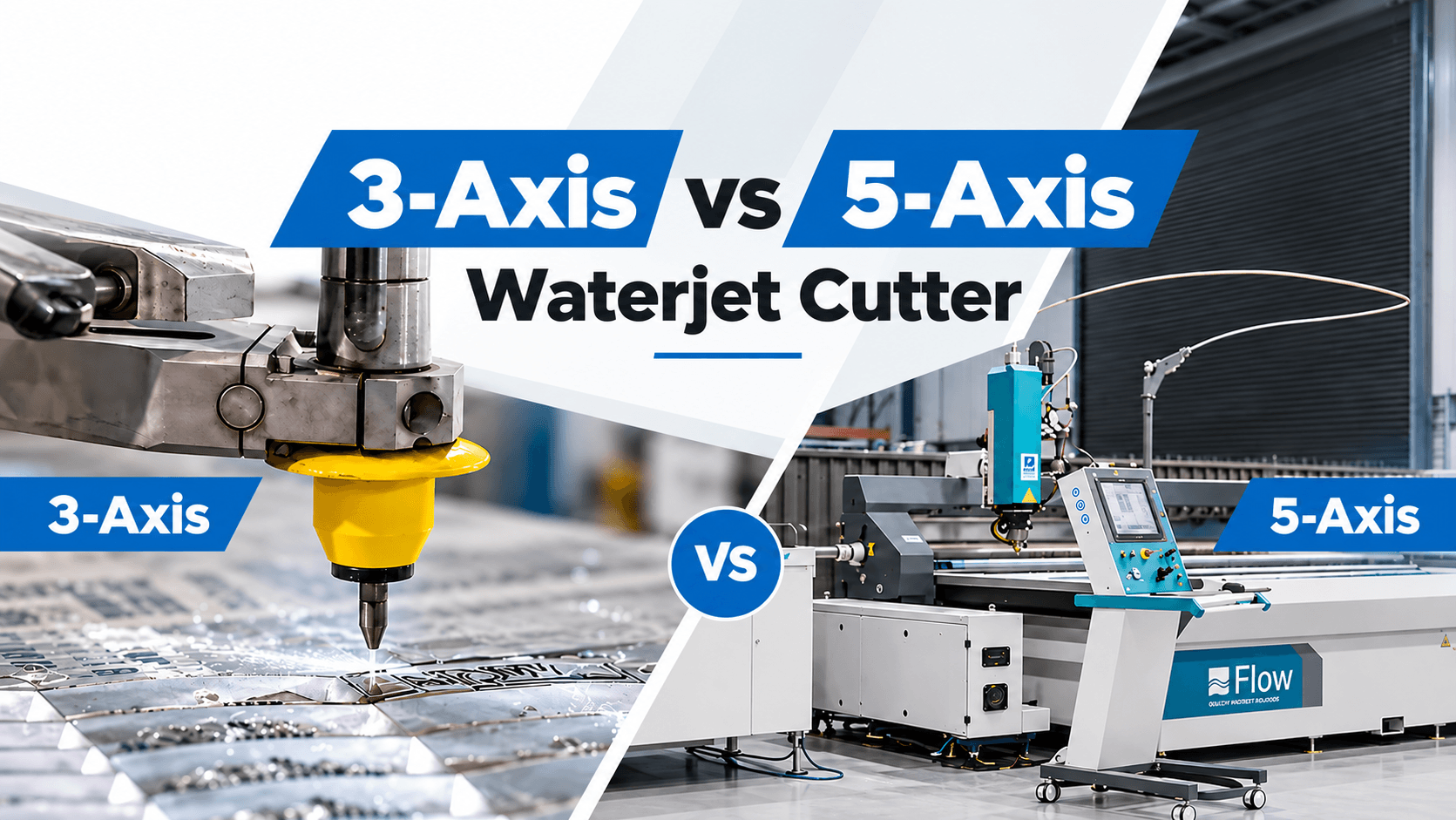
Choosing between a 3-axis and 5-axis waterjet cutter comes down to the geometry, edge requirements, and production workflow of the parts you need to make. A 3-axis system is designed for 2D profile cutting, while a 5-axis machine adds head movement for bevels, taper compensation, angled edges, and complex geometries. The right choice depends on your work.
3-Axis vs 5-Axis Waterjet: What's the Difference?
A waterjet cutter uses high-pressure water, with abrasive added for many hard materials, to cut without the heat-affected zone associated with thermal cutting. The axis configuration determines how freely the cutting head can move relative to the workpiece.
3-Axis Waterjet Cutting
A 3-axis waterjet moves the cutting head along X, Y, and Z axes. The jet remains essentially perpendicular to the material, making it well suited to flat sheets, plates and conventional 2D profiles.
This configuration is practical for:
- Straight cuts, curves, holes and internal cut-outs
- Steel, stainless steel, aluminium, stone, glass, composites and other suitable materials
- General fabrication and repeat production of flat components
Performatec's Flow Mach 150, for example, is a 3-axis waterjet system with programmable Z-axis movement and table configurations designed for day-to-day industrial cutting.
5-Axis Waterjet Cutting
A 5-axis system adds two rotary movements to X, Y, and Z. The cutting head can tilt and rotate to control the jet angle, allowing the machine to compensate for taper or cut bevels, mitres and complex profiles.
Performatec's Flow Mach 200 range includes 5-axis capability, taper compensation and bevel cutting up to 60 degrees, depending on configuration. The Mach 200c also combines 5-axis capability with a compact footprint for workshops where floor space matters.
3-Axis vs 5-Axis Waterjet Comparison
The key point in a waterjet axis comparison is that 5-axis does not automatically mean “more accurate” for every job. Both configurations can deliver high-quality cutting; the value of five-axis movement is the additional control over edge angle, taper, and geometry.
When to Use a 3-Axis Waterjet
When should you use a 3-axis waterjet? Choose this configuration when most of your production involves flat materials and conventional 2D profiles.
A 3-axis machine can be a sensible fit when you need:
- Reliable everyday cutting of sheet and plate
- Straight edges, curves, and internal profiles
- A simpler programming and operating workflow
- High repeatability without frequent bevel requirements
- A practical machine for general fabrication and mixed-material work
If drawings rarely specify angled edges or bevels, advanced multi-axis capability may add complexity without delivering a meaningful production benefit.
When to Use a 5-Axis Waterjet
A 5-axis waterjet becomes more valuable when the finished part requires the cutting head to change angle during the cut. This includes bevelled edges, angled features, taper correction, and some three-dimensional profiles.
Consider 5-axis capability when you regularly produce:
- Weld-preparation bevels
- Mitred or angled edges
- Components where edge squareness is critical
- Complex contours that would otherwise need another operation
- Parts where reducing secondary machining can improve workflow
Five-axis cutting can reduce handling because some angled features can be manufactured in the same setup. The benefit depends on part design, material, thickness, tolerance, and finish.
How Do You Decide Between 3-Axis and 5-Axis?
Start with the parts, not the machine specification. Review representative drawings and ask:
- Are most parts flat 2D profiles?
- Do drawings specify bevels, mitres, or angled edges?
- Does material thickness make taper control important?
- Are secondary machining or manual finishing steps adding time?
- Will future work require more complex geometries?
If the answer is mostly “no”, 3-axis waterjet cutting may provide the capability you need. If bevels, taper compensation, or complex angled geometry are recurring requirements, a 5-axis system may offer greater production flexibility.
Performatec can help manufacturers evaluate these requirements across its range of waterjet cutting systems, with supply, installation, commissioning, operator training and technical support.
What Is the Best Choice for Your Waterjet Cutting Requirements?
The 3-axis vs 5-axis waterjet decision ultimately comes down to what you manufacture, how complex your parts are, and what level of edge control your production requires. A 3-axis machine can provide an efficient solution for accurate 2D profiles, while a 5-axis system offers greater flexibility when bevels, taper compensation, mitres and angled geometries are part of the job.
Choosing the right machine is about more than comparing specifications. Performatec helps Australian manufacturers assess their cutting requirements and select machinery that fits their materials, production volumes, part complexity and future requirements. With more than 20 years of industry experience, Performatec provides a complete machinery solution covering machine supply, installation, commissioning, operator training, servicing, spares and ongoing technical support.
Whether you need the straightforward capability of a 3-axis system or the advanced cutting flexibility of 5-axis technology, Performatec can help you choose the right waterjet cutting system for your workshop and support it throughout its working life.


