
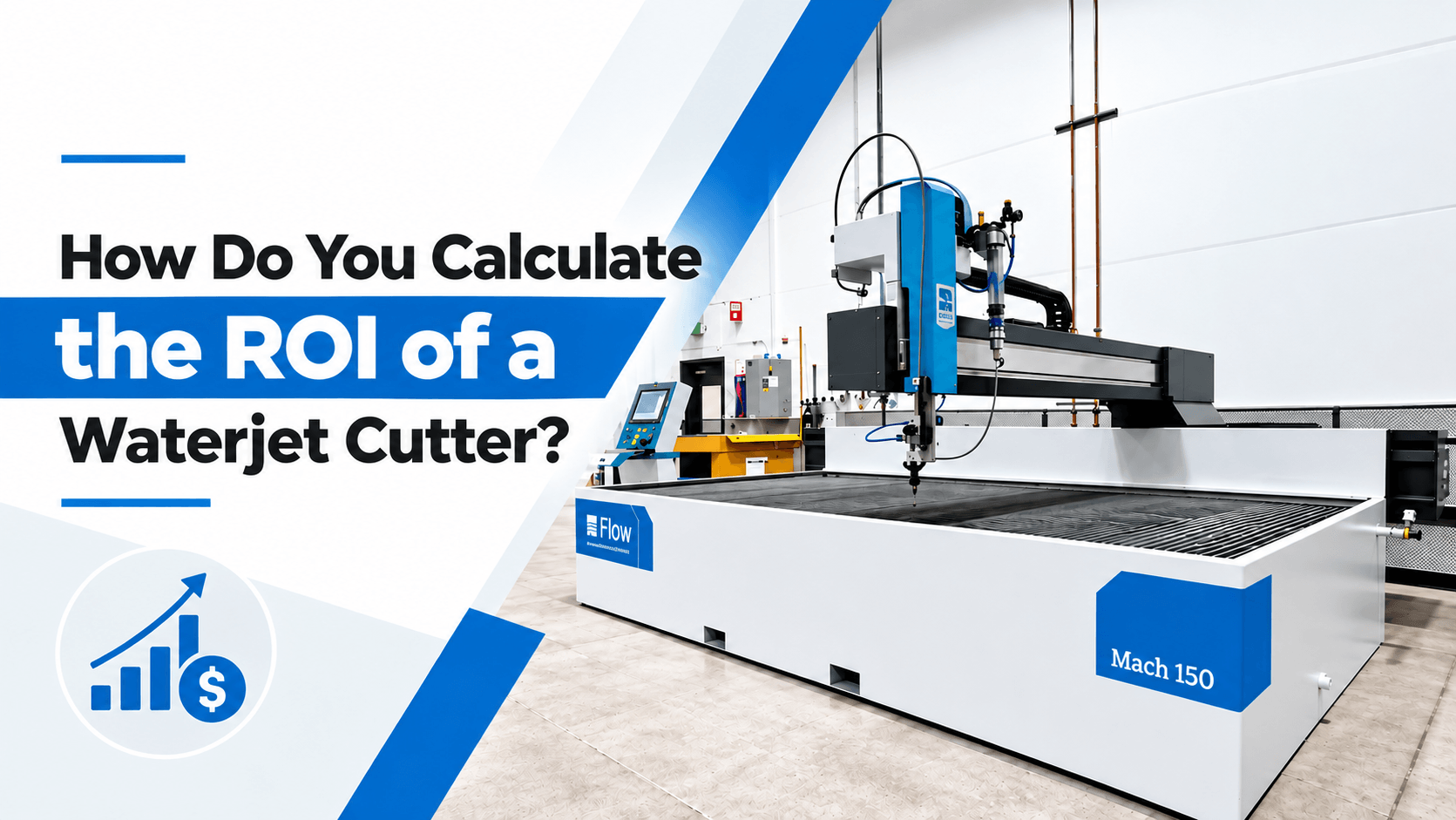
Calculating waterjet cutter ROI means comparing the total financial benefit a machine generates with the complete cost of buying and operating it. For Australian manufacturers, that means looking beyond purchase price to production output, pump selection, abrasive use, labour, maintenance, avoiding outsourcing, and material savings.
A useful ROI calculation should answer one question: Will the value this waterjet creates justify the investment over the period you expect to own and operate it?
Quick answer:
Waterjet ROI (%) = (Total financial benefit − total investment cost) ÷ total investment cost × 100
What Costs Should You Include When Calculating Waterjet Cutter ROI?
A realistic ROI model should consider the machine's total cost of ownership (TCO) rather than its quoted price alone.
Initial investment
Depending on the installation, upfront costs may include:
- Waterjet machine and high-pressure pump
- Abrasive hopper and Abrasive Sludge Removal (ASR) system
- Freight and site preparation
- Installation and commissioning
- Software and operator training
Pump specification deserves particular attention because it affects both production capacity and long-term operating costs. The right pump should therefore be selected around the number and type of parts the business needs to produce per hour or day.
Ongoing costs
Waterjet cutting operating costs typically include abrasive garnet, electricity, water, wear parts, labour, servicing and planned maintenance. Abrasive can be one of the largest consumable expenses, making cutting speed and abrasive efficiency important when calculating cost per part.
Downtime should also be assigned a cost where possible. Lost production caused by waiting for parts or technical support can change the economics of two otherwise similarly priced machines.
What Financial Benefits Can a Waterjet Cutter Deliver?
A waterjet generates a return when it reduces existing costs or creates additional productive capacity.
Potential financial benefits include:
- Bringing previously outsourced cutting in-house
- Increasing the number of parts manufactured per shift
- Reducing material waste through efficient nesting
- Reducing secondary processing on suitable components
- Shortening production lead times
- Taking on work involving different materials or complex parts
Use actual business figures wherever possible. If outsourcing is expected to fall, for example, calculate savings from real subcontractor invoices rather than an assumed industry average.
How Do You Calculate Waterjet Cutter ROI?
A straightforward waterjet machine ROI calculation can use:
ROI (%) = (Annual financial benefit − annualised costs) ÷ initial investment × 100
A 25% annual ROI means that for every dollar you put into an investment, you expect to earn 25 cents of profit over one year.
Consider a hypothetical manufacturer investing $300,000 in a waterjet. If the machine creates $150,000 in annual savings and additional contribution, while incremental annual operating costs total $75,000:
Annual net benefit = $150,000 − $75,000 = $75,000
ROI = $75,000 ÷ $300,000 × 100 = 25%
This is an illustrative example, not an expected return. Your calculation should use your actual production volume, labour rates, material costs, outsourcing spend, and anticipated machine utilisation.
How Do You Calculate the Payback Period?
ROI measures the relative return, while the payback period estimates how long it takes to recover the original investment.
Payback period = Initial investment ÷ annual net financial benefit
Using the example above:
$300,000 ÷ $75,000 = 4 years
Payback can be useful when comparing capital-equipment options, but it should not replace a longer-term TCO analysis. A machine with a faster theoretical payback may become less attractive if maintenance costs or downtime rise later.
What Can Affect the ROI of a Waterjet Cutter?
The same waterjet can produce very different returns in two workshops because utilisation, job mix and operating practices differ.
Material Utilisation - Change ‘valuable scrap’ to ‘scrap’
Important variables include:
When evaluating waterjet cutting technology, calculate several scenarios rather than relying on one ideal production forecast.
How Can You Build a More Realistic Waterjet ROI Calculation?
Start with representative parts and the required output per hour or day. This helps determine whether the proposed machine and pump can achieve the production rate behind your financial forecast.
For general jobbing, a 30-horsepower pump may be appropriate where its cutting rate meets required output. For higher production, Performatec recommends a 50-horsepower pump, which can improve cutting rates by up to 30% in many applications. Actual results depend on material, thickness, and cutting configuration.
For high-volume cutting of thick or hard plate, an 87,000 psi option can offer higher cutting rates and lower abrasive consumption per part.
Pump economics should also include:
- Recommended service intervals
- Cost of service parts
- Planned maintenance time
- Repair arrangements
- Availability of local technical support
- Whether major repairs can be performed onsite
Intensifier, direct-drive, and electric servo pumps have different service and repair considerations. Performatec's experience is that intensifier pumps can provide dependable industrial production with established maintenance procedures and accessible service support.
Why Should Performatec Be Part of Your Waterjet Investment Decision?
A strong waterjet investment return starts before the machine reaches your workshop. It depends on selecting equipment around actual parts, required throughput, pump performance, operating costs, and the support needed to keep production moving.
With more than 20 years of experience supplying machinery solutions to Australian manufacturers, Performatec’s expertise extends beyond selecting a waterjet. Performatec can help assess production requirements and pump configuration, then support the investment through machine supply, installation, commissioning, operator training, servicing, spares and ongoing technical support.
For manufacturers evaluating waterjet ROI, this whole-of-life approach matters. The right investment is not simply the waterjet with the lowest purchase price; it is the system capable of producing the required parts at a sustainable cost per part, with dependable support throughout its operating life.


