
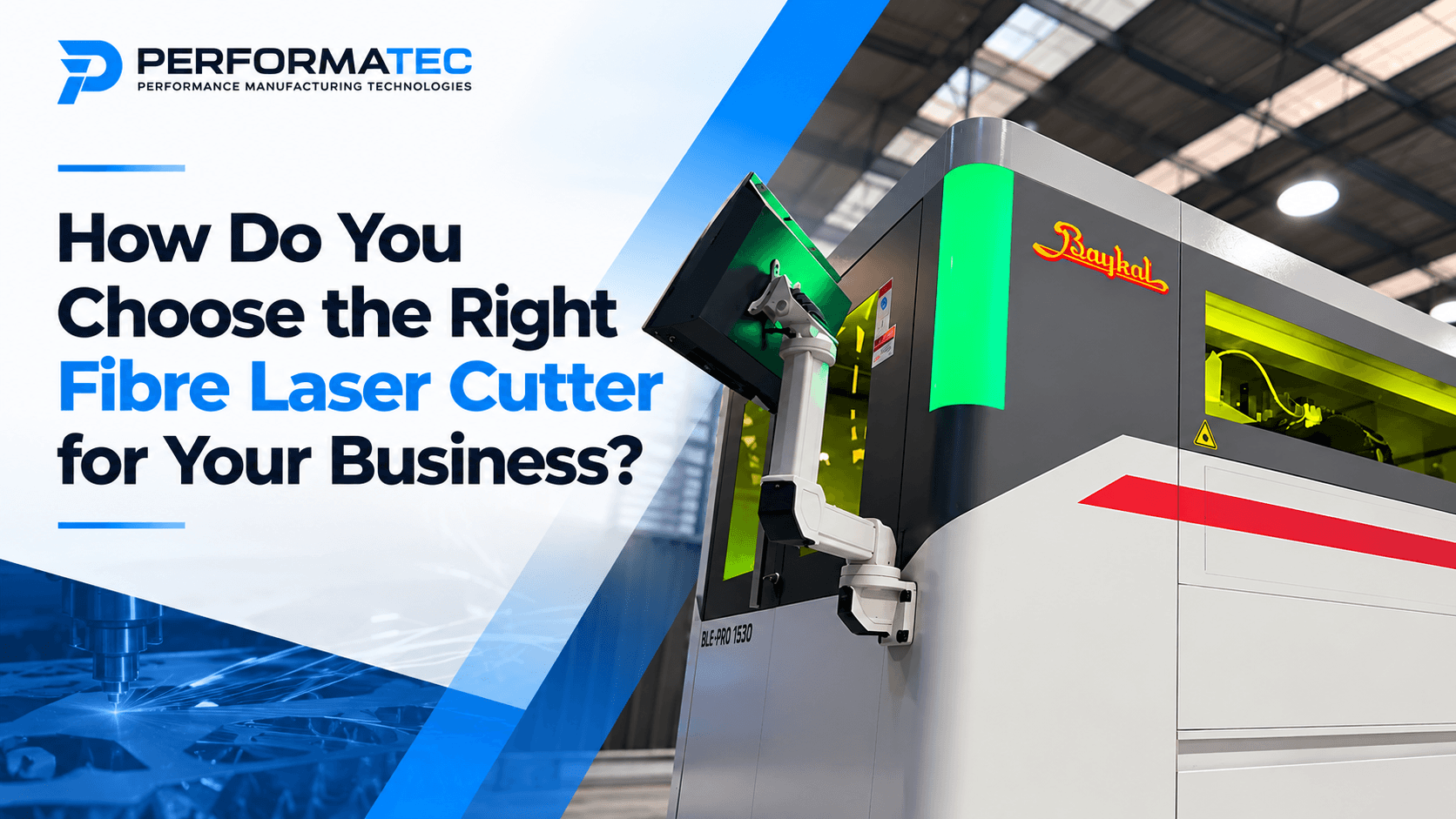
Choosing a fibre laser cutter requires more than comparing laser power or machine price. The right system should match the materials you cut, typical thicknesses, production volumes, required accuracy, workflow, and future capacity. Knowing how to choose a fibre laser cutter helps manufacturers invest in equipment that delivers reliable output rather than paying for capacity they may rarely use.
Start With the Materials You Cut Most Often
The first step in fibre laser cutter selection is identifying the metals and thicknesses your business processes most frequently. Fibre lasers are commonly used for materials such as mild steel, stainless steel, aluminium, copper and brass, but cutting performance varies according to material properties, thickness, laser power and machine configuration.
Create a practical material profile covering:
- Materials cut regularly
- Typical and maximum thicknesses
- Sheet and plate sizes
- Required edge quality
- Current production volumes
- Future materials you may need to process
For example, a fabrication business primarily cutting thin-to-medium sheet may have different requirements from a manufacturer regularly processing thick steel plates. Selecting equipment around actual production requirements prevents both under-specification and unnecessary capital expenditure.
Choose Laser Power for Performance, Not Just Maximum Capacity
Laser power affects cutting speed, material thickness capability and production flexibility. However, the highest available power is not automatically the best choice for every manufacturer.
When assessing laser power, consider the relationship between material, thickness, cutting speed and required output. A higher-power machine can provide greater capacity for demanding workloads, but its value depends on whether that additional capacity will be used consistently.
Performatec’s Baykal and Acufab fibre laser ranges include configurations from 1 kW through to 30 kW, allowing manufacturers to select equipment according to their production requirements. A useful selection question is: How many finished parts do you need to produce per shift, and what cutting capability is required to achieve that output?
Look for Precision and Consistent Cut Quality
A high-quality fibre laser cutter should deliver repeatable positioning and consistent edge quality throughout production. Precision matters because poor cutting consistency can increase scrap, rework, secondary finishing, and delivery times.
Machine architecture plays an important role. CNC controls, servo-driven motion systems, cutting heads, automatic edge detection, and nozzle management can all influence how reliably a system performs over repeated cycles.
For example, Performatec's Baykal range includes configurations offering accuracy of up to ±0.01 mm, while advanced cutting heads and motion-control components are designed to support repeatable production.
The goal is not simply to achieve a precise cut once. It is to maintain predictable performance across batches, shifts, and changing production schedules.
Evaluate Automation and Workflow Integration
Automation can significantly influence the productivity of a fibre laser cutter, particularly when production volumes increase. Features such as automated loading, unloading, shuttle tables, nozzle cleaning, adaptive nesting and real-time monitoring can reduce manual intervention and machine downtime.
When comparing fibre laser systems, assess automation according to the bottlenecks in your existing workflow.
Automation is particularly valuable when the objective is to increase machine utilisation without proportionally increasing manual labour.
Compare Fibre Laser Systems by Total Capability
Comparing machines solely by laser power or advertised cutting speed can give an incomplete picture. A proper comparison should consider the complete system and its long-term operating requirements.
Evaluate:
- Working area and table dimensions
- Laser power and source
- Cutting head and autofocus capability
- CNC and motion-control architecture
- Maximum material thickness
- Automation options
- Software and nesting capability
- Energy and consumable requirements
- Maintenance and servicing
- Spare-parts availability
- Operator training
- Local technical support
Performatec’s fibre laser range includes Acufab machinery, which is designed to provide reliable performance and excellent value for money. Performatec also offers the Baykal fibre laser range, which is a premium offering suited to more demanding applications where higher production volumes and superior technical specifications are required.
This type of comparison helps manufacturers assess the machine as a complete production asset rather than an isolated piece of equipment.
Choose a Fibre Laser Cutter That Can Grow With Your Business
A laser cutter should support today's production while allowing your business to take on new work. Future requirements might include thicker materials, larger sheets, higher volumes, tighter tolerances or greater automation.
Before investing, ask:
- Will the machine handle our expected material mix for the next several years?
- Can it accommodate higher production volumes?
- Can automation be added as requirements increase?
- Is technical support available locally?
- Are spare parts and servicing readily accessible?
- Can the supplier provide installation and operator training?
These questions are particularly important because capital equipment remains part of the production environment long after installation.
How Do You Choose a Fibre Laser Cutter Based on Business Requirements?
The best machine is the one that provides the right combination of power, cutting capability, precision, automation, working area, reliability, and support for your specific operation. Start with production requirements rather than selecting a machine based on specifications alone.
Why Performatec Can Help You Choose the Right Fibre Laser Cutter
Choosing the right fibre laser cutter is ultimately a production decision, not simply a machinery purchase. The correct system should match your materials and output requirements while improving workflow, consistency and long-term manufacturing capability.
Performatec combines fibre laser machinery with consultation, installation, commissioning, operator training, servicing and ongoing Australian technical support. Its range includes high-speed, precision systems with automation options designed for both agile fabrication and high-volume industrial production.
With more than 20 years of industry experience and a national network of CNC machine technicians, Performatec can assess your application and help identify the right configuration rather than simply the highest specification.
For Australian manufacturers evaluating fibre laser cutter selection, that combination of machinery expertise and ongoing support can be just as important as the laser itself.


