
Waterjet operators know that while the pump and orifice do the heavy lifting, it’s the waterjet nozzle that ultimately delivers cutting power to the workpiece. It’s where high-pressure water and abrasive converge into a focused stream that does the actual cutting.
So, what’s the right waterjet nozzle? Well, that depends on your priorities. While the nozzle won’t radically change cut quality, its size, durability, and consistency all influence how reliably your machine and workshop productivity perform over time.
A mismatched or low-grade nozzle can lead to premature wear, increased abrasive consumption, and more downtime; all issues that compound quickly in production environments.
This guide breaks down the three most common nozzle types our customers rely on, Roctec, Breakaway, and Silverline, and helps you match the right option to your needs, whether that’s long-term precision, collision protection, or cost-effective short runs.
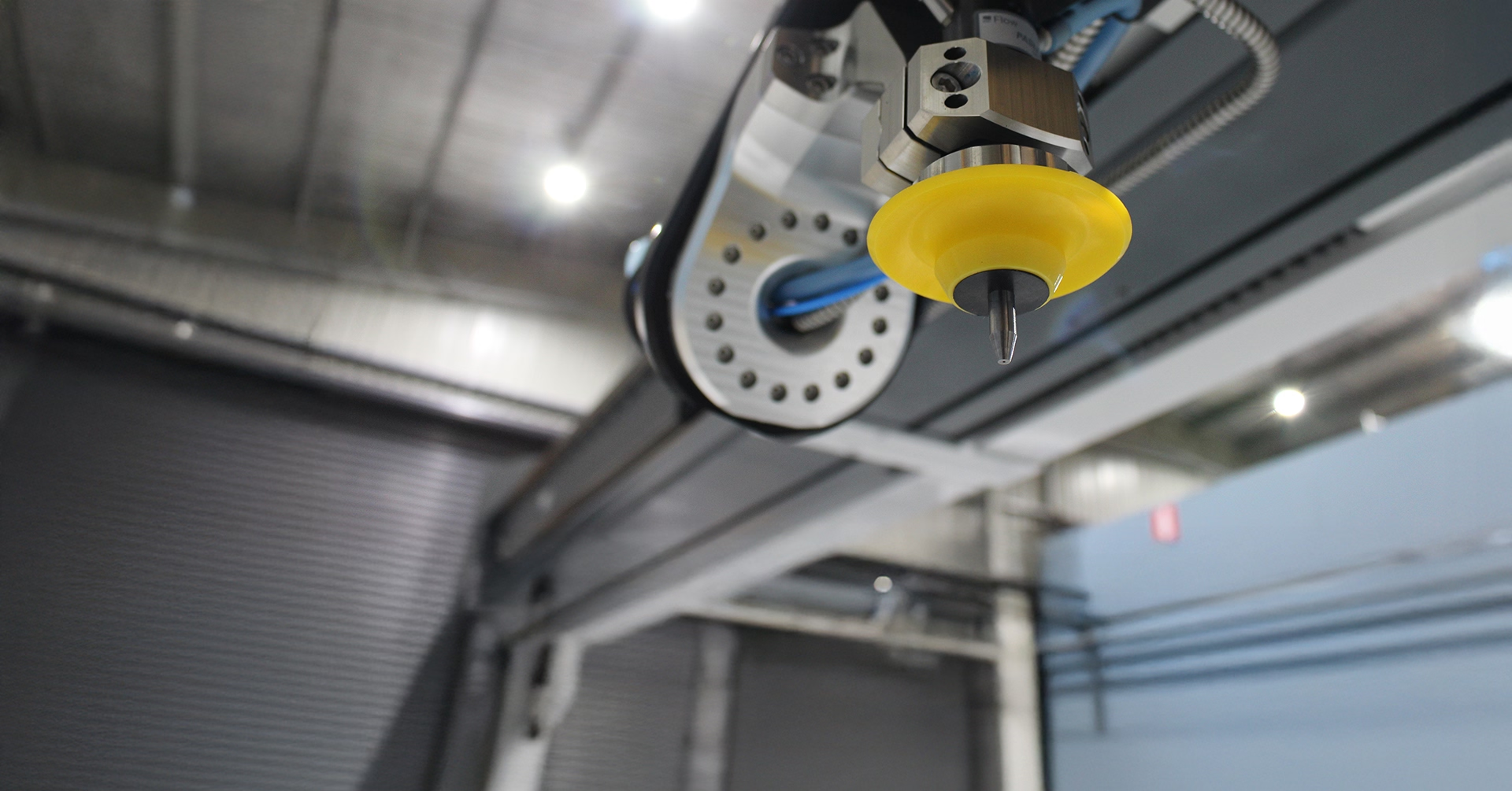

Nozzle selection plays a key role in the waterjet cutting process—especially when durability, uptime, and running costs are on the line. While small in size, the nozzle is the final link in the cutting chain and directly influences the consistency and efficiency of your output.
Here’s how the right nozzle choice impacts performance:
Key Takeaway - Selecting the correct nozzle is a strategic choice that directly impacts productivity, maintenance schedules, cutting consistency and the overall profitability of your projects.

Nozzle selection plays a key role in the waterjet cutting process—especially when durability, uptime, and running costs are on the line. While small in size, the nozzle is the final link in the cutting chain and directly influences the consistency and efficiency of your output.
Here’s how the right nozzle choice impacts performance:
Understanding wear mechanisms is fundamental to maintaining consistent performance in abrasive waterjet systems. Wear is not uniform across the nozzle and is influenced by abrasive selection, operational pressures, and system dynamics. Recognising early signs of wear allows operators to extend nozzle life and avoid unplanned maintenance.
Choosing the right abrasive is critical not only for achieving optimal cutting performance but also for preserving nozzle life and maintaining system stability.
Nozzle wear is heavily influenced by the type of abrasive in use. Harder materials like silicon carbide can accelerate wear dramatically, enlarging nozzle diameters up to three times faster than standard garnet abrasives. The most severe wear typically develops in the transition zone between the internal cone and cylindrical sections, where turbulent abrasive impacts create distinctive wave-like erosion patterns.
Routine inspection of the nozzle’s internal bore is essential for predicting lifespan and scheduling maintenance. Over time, geometric changes and material loss degrade mixing efficiency and jet uniformity, leading to poorer cut quality. Tracking dimensional shifts or minor deformations allows operators to estimate remaining service life accurately and plan maintenance activities before serious performance issues arise.
Choosing the right nozzle material directly impacts service life, operational cost, and overall system stability. Material advancements over recent years have provided operators with several options, each offering different balances between cost and longevity.
Tungsten carbide remains the industry standard for general-use nozzles, typically offering 30–40 hours of reliable service under standard cutting conditions. With premium options and good operating discipline—such as clean water, quality garnet, and proper alignment—lifespan can extend up to 60–120 hours. Choosing a nozzle that balances cost with durability helps minimise downtime and keeps production consistent without overspending on consumables.
Selecting higher-grade nozzle materials has a tangible impact on operational efficiency and long-term cost management. While the upfront investment may be higher, the extended service life of premium nozzles significantly reduces the frequency of replacements. This translates to fewer production stoppages, less maintenance overhead, and greater throughput consistency.
Key Takeaway - Investing in premium nozzle materials leads to cumulative savings, supporting leaner operations, improved stability, and higher productivity over time.
Precise and efficient material processing is not only about selecting the right nozzle materials or monitoring wear; the physical characteristics of the nozzle itself play a defining role. Geometry and system parameters shape how the abrasive and water interact, influence jet stability, and ultimately determine quality.
In this section, we take a closer look at how to deliver more efficient and consistent results.
The geometry of the nozzle directly shapes how the abrasive particles are accelerated and focused. Small variations in orifice size, mixing tube dimensions, and internal surface design can lead to significant changes in jet coherence and energy transfer. Fine-tuning these parameters offers a powerful lever to improve cutting efficiency, surface finish, and operational reliability without the need for major system modifications.
Correctly matching the orifice and mixing tube sizes is critical for achieving optimal abrasive entrainment and jet coherence. A general guideline is to maintain the orifice diameter at approximately one-third of the mixing tube diameter. For example, pairing a 0.20–0.25 mm orifice with a 0.76 mm mixing tube creates the conditions necessary for a focused, high-energy jet. Some advanced systems now feature helical internal geometries that further enhance velocity profiles and material removal rates without sacrificing stability.
Well-optimised nozzle geometry delivers more than theoretical improvements, it produces practical results on the cutting table. A uniform, coherent jet leads to cleaner edge finishes, faster cutting speeds, and reduced material wastage. In contrast, poorly matched or worn nozzle components can cause misalignment, inconsistent kerf widths, and increased secondary processing. Attention to geometric detail is a critical investment in overall process quality.
Beyond mechanical aspects, the quality of water used within the system plays a critical role in nozzle preservation. Poor water quality accelerates nozzle wear, increases operational instability, and contributes to unexpected maintenance requirements.
While high TDS can cause wear in pump components, it’s not the main threat to nozzles. The biggest contributors to nozzle failure are worn or misaligned orifices, damaged mixing chambers, and low-quality or contaminated garnet. These issues disrupt the abrasive flow and jet cohesion, accelerating wear and compromising cut quality. Maintaining tight orifice alignment and using clean, high-purity garnet are the most effective ways to extend nozzle life and ensure consistent cutting performance
Consistently managing water quality reduces flow fluctuations and mechanical stress within the system. This not only extends nozzle life but also enhances overall machine reliability, allowing for longer uninterrupted production runs and a higher return on capital equipment investment.
Key Takeaway - Optimising abrasive waterjet nozzle performance is not achieved through any single tweak. It requires an approach that carefully balances material science, system design, operational discipline, and proactive maintenance.
Selecting the right nozzle plays a big role in getting the best out of your waterjet. It affects not just cutting performance, but also day-to-day stability and cost control.
Every nozzle type brings its own strengths depending on the job at hand, your machine setup, and what you are aiming to achieve. When you understand the differences in material construction, wear resistance, and design focus, it becomes much easier to pick the nozzle that best matches your priorities on the floor.
In this section, we break down three main types of waterjet nozzles that are the most popular and ordered from our spare parts dept. Roctec, Breakaway, and Silverline. We'll compare how they are made, how they typically perform over time, and where each one fits best. Because there is a fair bit of ground to cover, we have split the information into smaller sections to make it easier to navigate.
Roctec nozzles, manufactured in the United States by Kennametal, are globally recognised for their exceptional performance characteristics. Unlike standard tungsten carbide nozzles, Roctec nozzles are produced using a proprietary Rapid Omnidirectional Compaction (ROC) process that combines advanced ceramic materials without the need for a soft metal binder. This unique manufacturing process minimises ceramic particle enlargement during high-heat exposure, maintaining an extra-fine grain structure that significantly enhances performance.
Roctec nozzles are available in three distinct performance grades:
All Roctec nozzles feature:
These nozzles are often the choice for high-production environments where uptime and repeatable quality are critical.

Now that we’ve looked at how Roctec nozzles perform, let’s turn our attention to two other options: Breakaway and Silverline nozzles. Each of these has its own strengths-whether you need to protect delicate 5-axis systems or you’re after a budget-friendly solution for everyday cutting.
To make things simple, we’ve highlighted the main features, technical points, and real-world uses for each nozzle. This way, you can easily see which one fits your needs-without getting lost in complicated technical jargon.
Breakaway nozzles are a newer development designed specifically with 5-axis waterjet systems in mind. Unlike traditional designs, these nozzles feature a fusible joint or intentional fracture point to prevent major damage during collisions.
5-axis waterjet systems introduce advanced cutting capabilities, such as:
In these complex setups, Breakaway nozzles serve a critical role—not just in durability, but in operational safety and maintenance efficiency. Their design includes:
Although Breakaway nozzles come at a modest premium (typically 15–20% higher), they offer peace of mind when working with high-value parts or multi-axis systems where errors can be expensive.
Silverline nozzles are a budget-friendly option for general-purpose waterjet cutting. Manufactured in China, they offer reasonable performance for low-risk or short-run applications.
Key features include:
The main trade-off is consistency. Unlike Roctec nozzles, which deliver highly uniform performance across batches, Silverline nozzles can vary in wear rate and lifespan. For operations where repeatability and precision are less critical, they represent a practical, economical choice.
Key Takeaway - Choosing the right nozzle, whether Roctec, Breakaway, or Silverline, comes down to matching performance needs with operational priorities, balancing precision, durability, protection, and cost efficiency.
While each nozzle type-Roctec, Breakaway, and Silverline-has its unique strengths, understanding their material composition, manufacturing process, expected lifespan, wear rates, and cost implications can help you select the right fit for your production environment.
The following technical comparison table distils these critical specifications into an easy-to-reference format. Whether your priority is precision, durability, collision protection, or cost efficiency, this table provides a comprehensive overview.
Selecting the best waterjet nozzle is not just about the initial cost, but about how it affects your entire operation over time. A careful evaluation of your cutting requirements, machine setup, and production needs will help ensure the right choice for consistent results and long-term value.
By carefully weighing these technical factors, you can select the waterjet nozzle that delivers the optimal balance of performance, protection, and value for your specific cutting requirements.
If you would like help selecting the right nozzle, our spare parts specialists are more than happy to discuss your needs. Simply get in touch with us by clicking this link!
Join a growing list of manufacturing professionals receiving equipment and technology updates.
