
So... You saved $75 on a ton of waterjet cutting garnet. But, it cost you three hours of downtime and a frustrated machine operator.
Sub-par garnet doesn't just wear parts faster. It kills uptime, destroys tolerances, and turns your precision cutting centre into a maintenance nightmare. Once you factor in nozzle wear, rework, and unplanned downtime, that 'cheap' garnet becomes the most expensive decision you'll make this month.
Regardless of whether you own the business or operate the machinery, you know that every hour of downtime, every rejected part, and every premature component replacement directly impacts profit. Yet, many operations continue to chase the lowest unit price on waterjet abrasives, overlooking the total cost.
This article breaks down the hidden factors behind bargain-bin garnet and demonstrates why premium abrasives like GMA Garnet™ deliver superior return on investment.

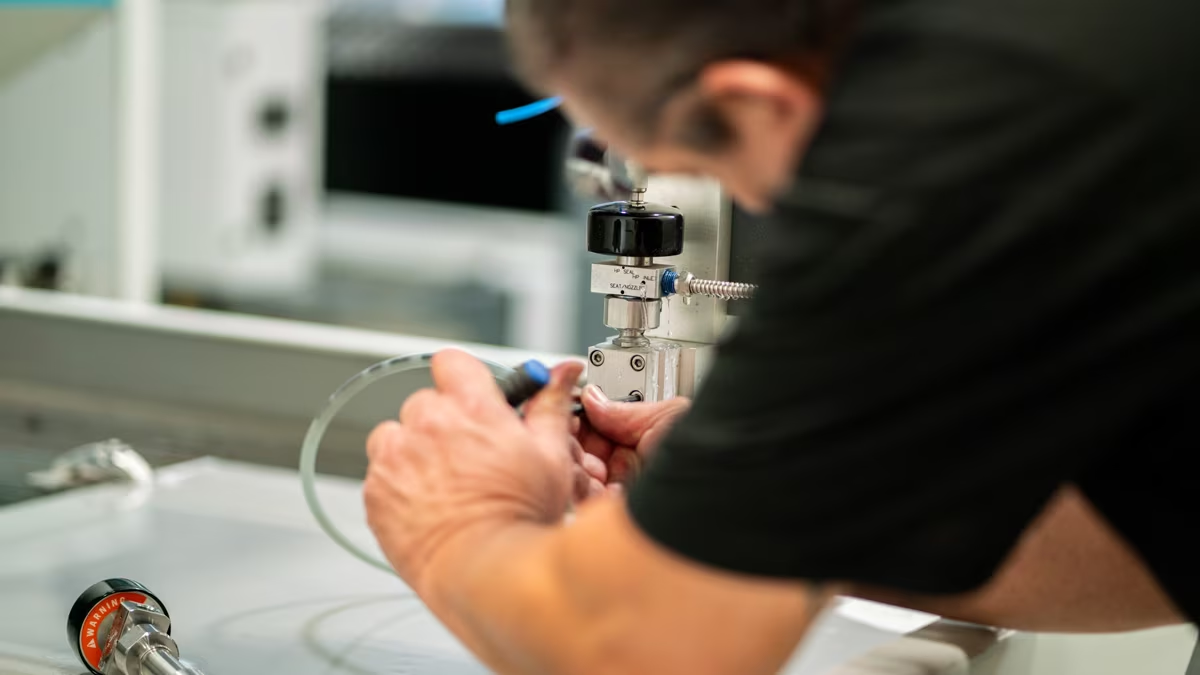
It's easy to see why low-cost garnet makes it onto a purchase order. On paper, the numbers look good. But chasing the cheapest waterjet garnet often ignores the downstream consequences – the mechanical failures, rework, lost time, and firefighting that show up weeks after the invoice clears. What starts as a line-item saving often becomes an operational liability.
Abrasive quality has a direct impact on wear rates inside your cutting system. Cheap garnet typically contains fractured particles, metallic inclusions, fine dust, silica and mud – all of which behave more like erosion media than cutting tools. These contaminants rip through precision components like mixing tubes and focussing nozzles, degrading the internal geometry designed to maintain jet coherence and cutting accuracy.
When a $400 mixing tube is rated for 80 hours and burns out in 50 because of substandard abrasive, that's a $150 loss per unit – before you even factor in change-out time, lost production, or interrupted jobs. Now, apply the same logic to the nozzle. A $600 nozzle that should last 200 hours but fails at 120 adds a $6/hour penalty to your job cost. Multiply that across multiple heads and double shifts, and your "cheap" abrasive becomes a slow, silent profit drain.
Low-grade garnet doesn't just wear out your gear – it destabilises the entire cutting process. Inconsistent grit size and irregular particle shape compromise edge quality and dimensional accuracy. What should be a clean, first-pass cut becomes a patch-up job, with operators spending their shift adjusting parameters instead of producing parts.
When a $500 stainless or high-tensile steel component destined for a defence contract or infrastructure project ends up out-of-spec, it's rarely recoverable. That single reject represents more than just wasted material – it's machine hours, setup time, operator input, and schedule allocation gone with it. And, while a 5 per cent rework rate might seem tolerable on paper, across a full production cycle, it quietly erodes output, clogs up the workflow, and sends high-value parts either to reprocessing or straight to scrap.
Downtime caused by abrasive flow issues is one of the most common and, unfortunately, most overlooked sources of lost productivity. Low-grade garnet often bridges in hoppers and clogs feed lines, and it can cause a variable flow that shuts down your machine mid-cut.
Those disruptions hit hardest in multi-shift operations. A blockage at 2 AM doesn't just stall the night crew – it delays the morning shift, pushes back deliveries, and sets off a chain reaction of catch-up jobs, overtime blowouts, and missed production targets.
When your water jet system is running full-tilt, there's no margin for unreliable inputs. And garnet (more than any other consumable) quietly determines whether the shift stays on track or descends into fire-fighting mode.
Quality garnet functions as operational insurance, ensuring your waterjet cutting system remains predictable, components achieve their rated service hours, and production schedules stay on track.
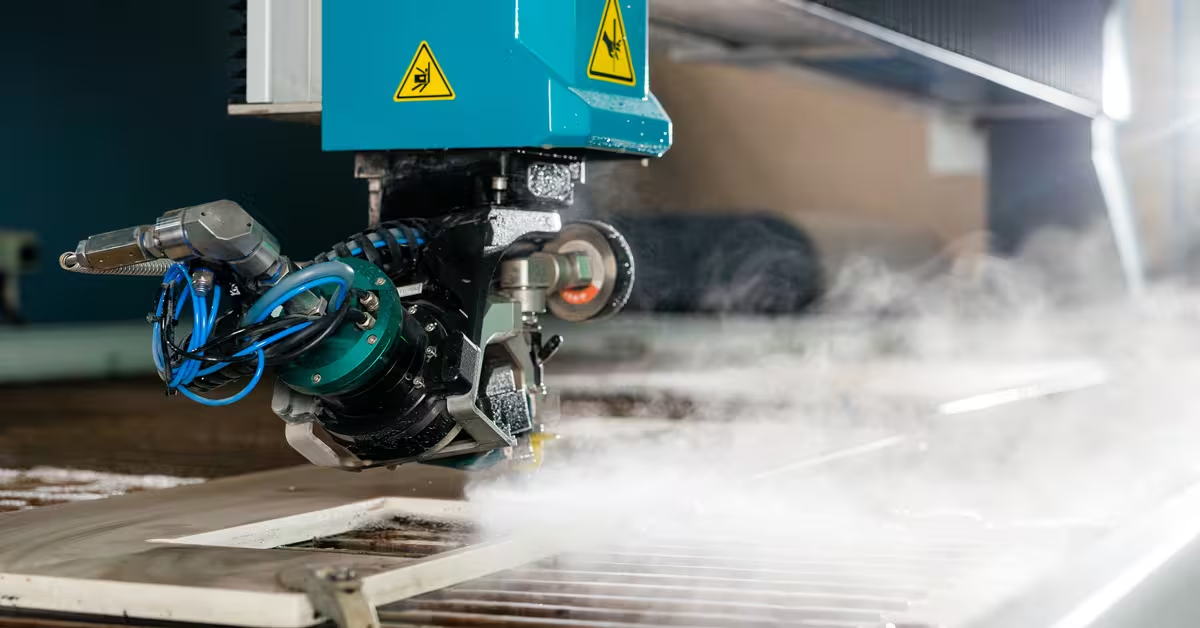
At its core, waterjet cutting is a physics-driven process. Garnet particles are accelerated to supersonic speeds inside a high-pressure water stream, acting as microscopic cutting tools. For the system to function effectively, those particles need three things: hardness, shape, and consistency.
High-quality garnet is hard enough (7.5–8.5 on the Mohs scale) to maintain cutting pressure throughout the process. But it's not just about raw hardness – it's about how the particles behave under load.
Premium garnet is selected and processed to fracture in a controlled way, continually exposing fresh cutting edges as it breaks down. This controlled fragmentation keeps cuts sharp, clean, and efficient.
Poorer-quality garnet often includes softer minerals that don't cut – they crush. These contaminants reduce cutting efficiency, increase abrasive consumption, and lead to inconsistent material removal. Over time, this means more rework, slower cycles, and higher cost per part.
Waterjet systems are unforgiving when the abrasive flow isn't stable. Irregular particle sizing, excess fines, and dust – all common in recycled or low-grade garnet – can cause bridging in hoppers, feed line clogs, and unstable flow rates. When this happens mid-cut, your operators are forced to stop, clear the system, and recalibrate – sometimes several times per shift.
These aren't theoretical failures. They translate to lost hours, missed delivery windows, and machine schedules blown out by what should be routine material input.
Consistent garnet flow stabilises cutting speed, kerf width, and edge accuracy. That means fewer rejects, tighter tolerances, and less downtime. In high-output shops, this consistency is what separates a profitable week from one lost to rework and troubleshooting.
Cheap garnet might lower your cost per bag – but once you account for its impact on flow stability, nozzle life, and rework rates, it rarely lowers your cost per part.
If inconsistency is the problem, then it makes sense to look upstream. The way garnet is formed, processed, and graded has a direct impact on how it performs in your machine. For operations that rely on stable flow and repeatable results, not all abrasives are created equal. That's where GMA has built its reputation – not on price tags, but on decades of doing the job right.
Garnet quality determines whether your waterjet system functions as a precision manufacturing tool or devolves into an unreliable bottleneck demanding constant operator intervention.
GMA Garnet has established itself as the global benchmark for waterjet cutting abrasives through four decades of continuous refinement (pun intended). Established in Western Australia, the company pioneered the use of naturally occurring alluvial garnet for industrial applications long before the waterjet sector became what it is today.
Unlike crushed alternatives that are mechanically processed from hard rock sources, GMA's garnet is formed through natural erosion and sedimentation. This geological advantage produces a sub-angular grain with fewer internal fracture lines, leading to smoother flow, lower dust, and more predictable wear characteristics. In short, it behaves better under pressure.
But the material is only part of the story. GMA's processing methods are explicitly designed for waterjet applications. Every batch is washed, graded, and screened to tight tolerances, removing oversized grains, fines, and mineral contaminants that can affect waterjet cutting machine performance or cut quality.
GMA waterjet garnet contains up to 98% pure almandine garnet — one of the highest purity levels available in the market. This composition eliminates the inconsistencies caused by mixed mineral abrasives, helping maintain consistent density, hardness, and cutting behaviour across every bag.
For GMA, quality control isn't just a checklist. It's baked into every step of production. The QC team doesn't just sample bags here and there. They systematically monitor:
It's that kind of rigour that sets GMA apart. You're not getting a generic bulk mineral. You're getting a material that's been purpose-built (and obsessively refined) for the demands of modern waterjet cutting. [1].
From hopper to nozzle, every part of your system relies on an abrasive that flows consistently and cuts cleanly. That's why GMA has engineered its range to suit the real-world demands of modern workshops, not just lab tests or spec sheets.
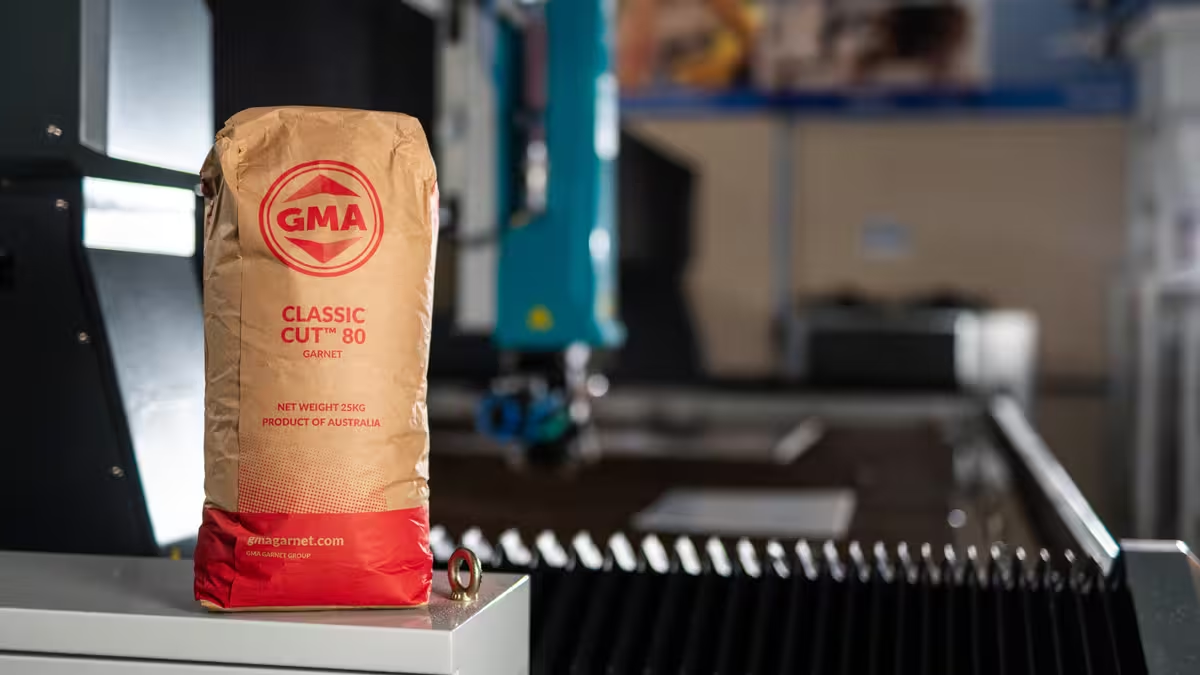
GMA's abrasive range is built to meet the needs of small, medium and large output workshops, with multiple grades tailored to different cutting demands. While an extensive range is available, for most Australian workshops, ClassicCut™ remains the standard. It delivers consistent results across a broad mix of materials, from light-gauge aluminium to thick mild steel, without the flow issues or rework headaches that come with low-grade garnet.
ClassicCut™ waterjet cutting garnet is available in 60, 80, and 120 mesh sizes, each suited to specific machine setups and cutting applications.
The most commonly used 80 mesh is optimised for orifice sizes between 0.25 and 0.33 mm, paired with mixing tubes from 0.76 to 1.02 mm. For finer detail work, 120 mesh supports smaller setups down to 0.18 mm orifices and 0.51 mm tubes. This flexibility makes ClassicCut™ compatible with a broad range of systems and ideal for workshops dealing with varied material types and job requirements.
Across all mesh sizes, operators rely on ClassicCut™ for its:
It's the preferred abrasive for high-mix, high-output environments where reliability matters more than theory — and performance needs to hold up under pressure.
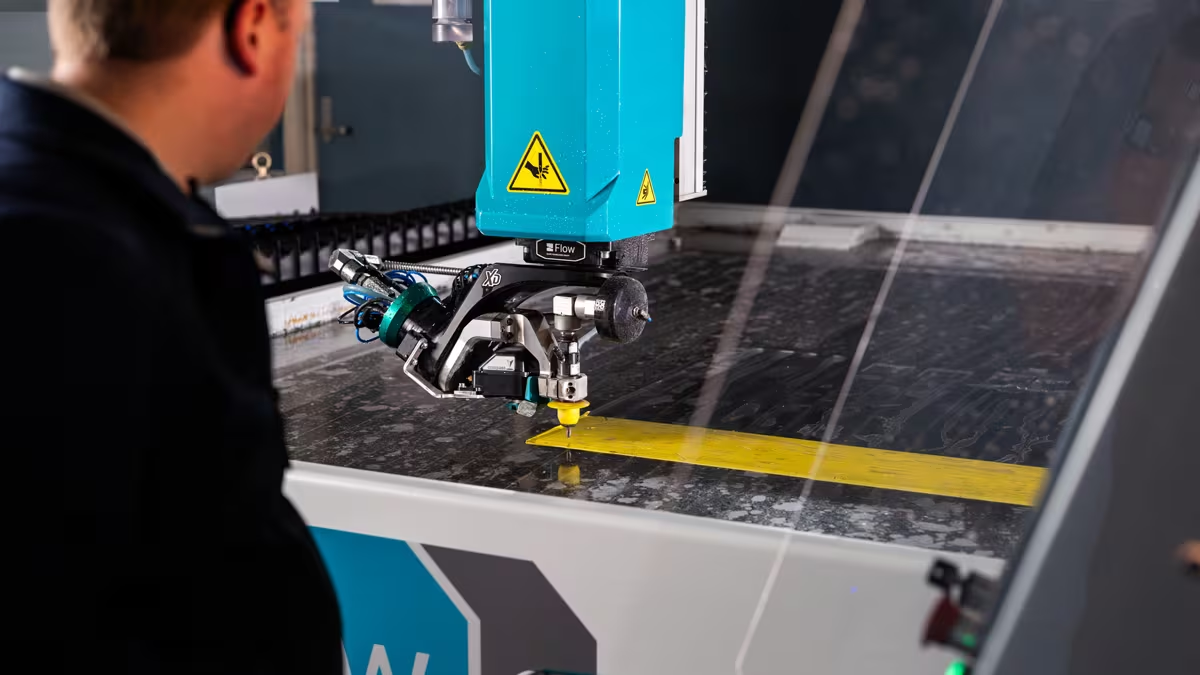
Generally, in the market we see the vast majority of manufacturers using 60,60 or 120 mesh GMA Classic cut. However, for specialised applications, GMA's other products offer targeted performance benefits:
Even the best abrasive is only helpful if you can get it when you need it. Performatec maintains strategic stockpiles of GMA Garnet across Australia's East Coast, ensuring consistent supply for workshops that can't afford to sit idle.
Whether you're running a single cutting table or managing a multi-machine operation, Performatec has the infrastructure to keep you moving. We stock a full range of critical spares, focussing nozzles, mixing tubes, orifices, all ready for next-day dispatch. And when technical issues arise, our network of experienced technicians in every capital city means help is never far away.
While the following case studies come from GMA's broader global network, the outcomes speak directly to the value of using high-quality abrasive in the proper supply environment: lower downtime, reduced wear rates, and better output. These are the same principles we bring to every workshop we support across Australia.

The benefits of premium water jet garnet are not just theoretical. They show up in the numbers. Case studies across multiple industries (and the following examples) consistently report less downtime, lower consumable costs, and higher output after switching from cheap abrasives to premium-grade garnet. These results make a clear business case: quality abrasives pay for themselves in performance.
Facing frequent breakdowns and unpredictable maintenance cycles, Smith & Nephew transitioned to GMA ClassicCut™ to stabilise their production environment. Within the first month:
The improved abrasive performance allowed better control over delivery schedules, a critical factor in regulated medical manufacturing, where consistency and precision aren't optional [2].
Jacquet Nova, a leading stainless steel supplier in Italy, sought to improve quality when cutting 40mm AISI 304 (a material that suffered distortion), HAZs, and oxide contamination during laser cutting.
Switching to a 60,000 psi waterjet system using GMA ClassicCut™:
The result was a more precise, spec-compliant product better suited for architectural and infrastructure projects. Based on these outcomes, Jacquet Nova has expanded its investment in waterjet cutting as a quality-first alternative to laser [3].
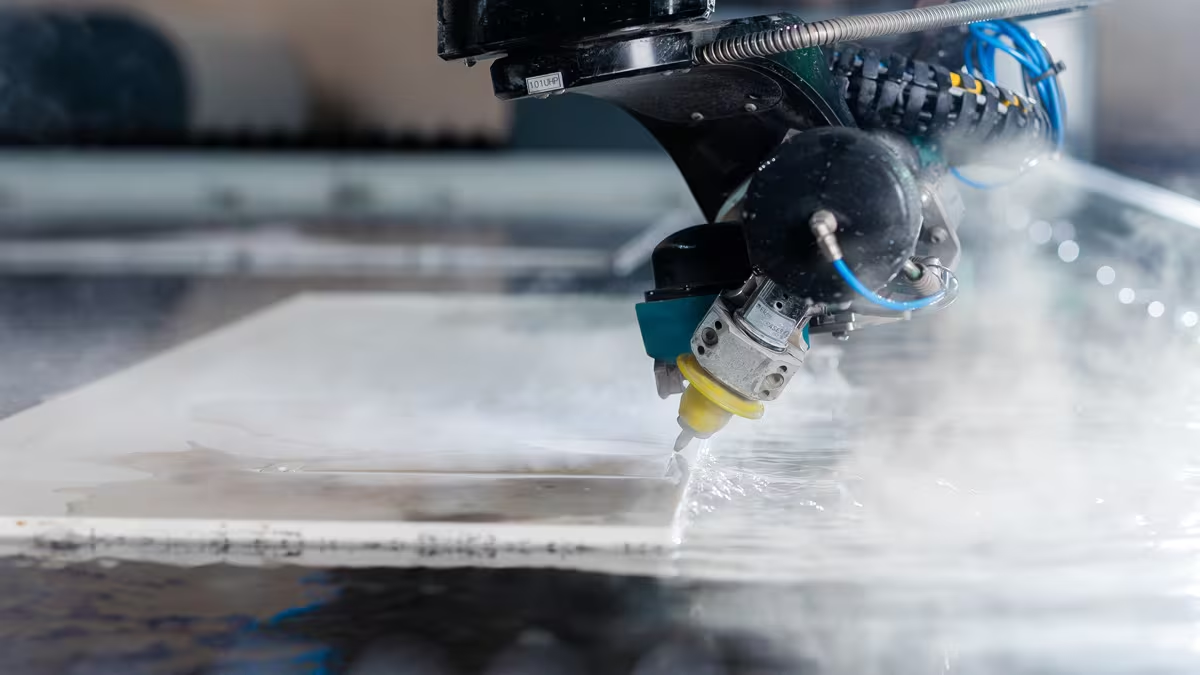
Comparing garnet on unit price alone is false economy. You're not just paying for a bag of dirt, you're paying for what that abrasive does to your system, your output, and your margins.
Let's say economy-grade garnet runs at $1.20/kg, while premium garnet comes in at $1.50/kg. On paper, that's a 25% saving. But in practice, premium abrasives often:
When those factors compound over a month of production, the cheaper option typically costs more – not less. The difference shows up not just in your maintenance log but in delivery delays, operator frustration, and lost capacity.
Once they have moved over to premium waterjet cutting abrasives, operators usually notice the change in the first few shifts. Flow becomes more stable. Dust and fines stop clogging the feed system. Cut parameters hold steadier, and parts hit spec on the first pass more often. Instead of chasing machine errors or babysitting worn components, operators can focus on actual production.
Over the long haul, it's the wear and tear you don't see that really adds up. Better garnet reduces abrasive-induced erosion across your system. That means fewer nozzle changes, more predictable maintenance cycles, and fewer emergency breakdowns chewing up your week.
It also means schedulers can quote tighter turnaround times with confidence – knowing machines will stay online, parts will pass inspection, and customers won't be calling asking where their order went.
Premium garnet isn't a luxury. It's an operational decision. If you're trying to get the most out of your machines, your people, and your margins, abrasive quality is a lever worth pulling.
Ready to cut smarter?
Speak to our WaterJet Garnet Abrasives team for pricing, tech advice, or to get matched with the right grade for your operation. We’ll help you get the most out of every shift, without the rework or downtime.
[1] GMA Garnet Group (2024) Waterjet garnet products: the world's most popular waterjet garnet. Available at: https://gmagarnet.com/en/waterjet-garnet [Accessed: 16 June 2025].
[2] GMA Garnet Group, (2023). Case Study – GMA ClassicCut – Smith and Nephew. Available at: https://gmagarnet.com/resource-hub/case-study-gma-classiccut-smith-and-nephew [Accessed 16 June 2025].
[3] GMA Garnet Group, 2024. Comparative study of waterjet vs. laser cutting for stainless steel [online]. Available at: https://gmagarnet.com/resource-hub/comparative-study-of-waterjet-vs.-laser-cutting-for-stainless-steel [Accessed 16 June 2025].

Join a growing list of manufacturing professionals receiving equipment and technology updates.
