
Industrial Laser Cutters: Beyond the Hype
In the Australian manufacturing sector, industrial laser cutters are pivotal for operational efficiency, product quality, and competitive differentiation.
Yet, beneath the marketing gloss, not all machines are engineered for the relentless demands of real-world production.
This article strips away the hype, providing a technical exploration of fibre laser cutter architecture, performance, and support, using Baykal’s BLE-Pro and BLS-Pro systems as a benchmark for what ‘industrial-grade-fibre laser’ truly means.
The article focuses on the systems that directly impact uptime, repeatability, and long-term return on investment.
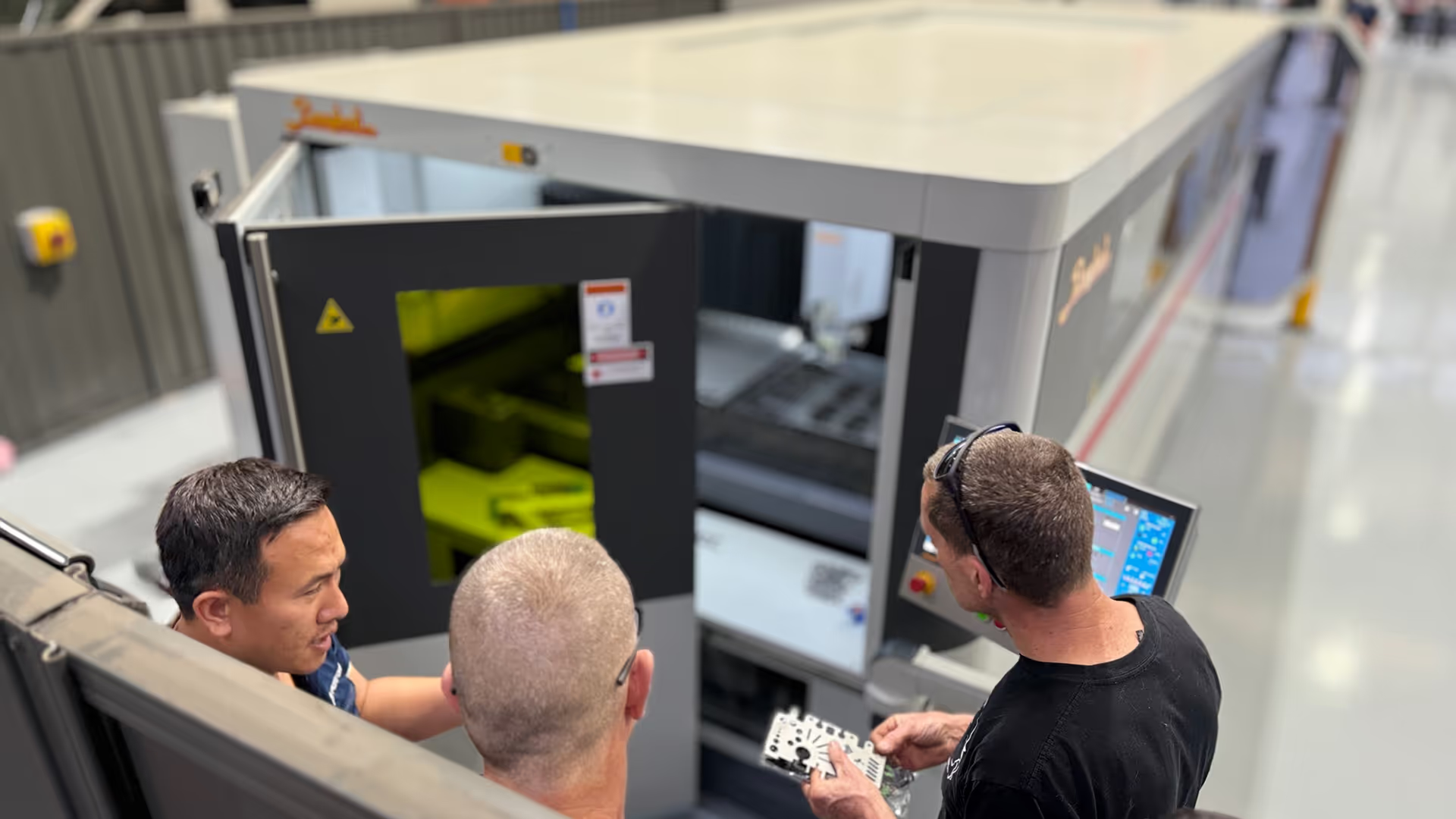

The Performance Driver of an Industrial Laser Cutter
When comparing industrial laser cutters, the machine's underlying architecture is where the serious differences emerge. This section breaks down the key subsystems that govern not just performance but the long-term reliability and productivity of your investment. From motion mechanics to control platforms, these are the areas that separate a showpiece from a true workhorse.
Motion Control in Fibre Laser Systems
In a laser cutting system costing upwards of a million dollars, precision is non-negotiable, and the motion control system is where this precision is most critical. Rather than being a single off-the-shelf unit, it is a carefully engineered integration of components from multiple OEMs, such as drives, motors, encoders, and rails. All are designed to work seamlessly together. In a reliable, high-end laser cutter - every part is chosen for reliability, accuracy, and compatibility, ensuring the machine delivers consistent, repeatable results shift after shift, regardless of workload or material.
While often reduced to 'positional accuracy' in marketing materials, motion control systems are the determining factor in a laser cutter's ability to maintain micron-level tolerances across thousands of cycles. In high-speed manufacturing environments, even minor deviations in acceleration curves, axis synchronisation, or positional feedback loops compound rapidly, leading to:
Thermal Drift in Motion Systems
Poorly engineered drives and bearings expand under load, altering cutting paths during extended runs. However, precision machines use low-expansion alloys, active cooling, and real-time compensation algorithms to maintain accuracy, even during long production cycles.
Backlash and Repeatability
Cheap rack-and-pinion systems develop slop over time, creating inconsistent kerf widths. Yet, advanced designs use preloaded ball screws, helical rack systems, or anti-backlash gearboxes to eliminate play and ensure consistent, repeatable motion.
Resonance artifacts → Vibration and Cut Quality
Underdamped gantries vibrate at high speeds, distorting intricate geometries. To mitigate this, high-end systems employ rigid frame construction, optimised gantry design, and integrated vibration damping to suppress resonance, allowing for precise, high-speed cutting of complex shapes.
Advanced systems like Baykal's Bosch Rexroth linear drives and Wittenstein servo reducers address these through:
- Closed-loop feedback - Real-time encoder data (≤1μm resolution) corrects position 4,000x/second
- Dynamic rigidity - Pre-tensioned linear guides with 30% over-engineering for vibration damping
- Thermal compensation - Embedded sensors adjust motion paths based on ambient/component temperature shifts
The result? Positional repeatability of ±0.01 mm (10 μm) is maintained even during continuous, multi-shift production of defence-grade components or automotive chassis parts. For manufacturers, this translates to reliable first-pass yield rates and the ability to process mild steel up to 60 mm thick (with 30 kW), all while maintaining consistent edge quality and dimensional accuracy within ±0.01–0.02 mm. Cutting speeds for thick mild steel will vary by application, but the BLS-Pro series delivers high productivity without sacrificing cut precision or edge squareness.
True industrial-grade laser cutters are defined by their motion systems because without precision and repeatability, everything else is just a demo.
CNC Systems in Industrial Laser Cutters
The CNC control system for an industrial fibre laser cutter is the central nervous system. Its role extends far beyond basic G-code interpretation; it must deliver high-speed, high-precision motion, seamlessly interface with upstream and downstream systems, and remain robust against electrical and thermal disturbances over extended production cycles.
Why CNC laser platform design matters
Closed or proprietary CNC environments can significantly restrict operational flexibility. They complicate automation integration, increase maintenance costs, and often lock manufacturers into a single-vendor ecosystem. The long-term impact is a higher total cost of ownership, limited scalability, and reduced competitiveness. [expand by 1 paragraph]
Baykal's open CNC control architecture
Baykal employs Beckhoff control systems, which are renowned for their open, modular architecture and industrial-grade reliability. Beckhoff platforms are designed for scalability and seamless integration with a wide range of automation and manufacturing execution systems (MES). Key advantages include:
- Open integration - Direct compatibility with MES platforms, industrial robotics, and SCADA/Industry 4.0 solutions.
- Customisation - Support for user-defined automation routines and macros written in IEC 61131-3 languages, enabling tailored workflows and advanced logic directly within the control environment.
- Future-proofing - Modular hardware and software architecture allows for straightforward upgrades, retrofit automation, and expansion as production requirements evolve.
Baykal CNC Laser Cutter Specifications
Baykal employs a Beckhoff CNC platform that is built on an IPC-based architecture, utilising real-time EtherCAT fieldbus technology to ensure deterministic communication and precise synchronisation across all system components. This foundation enables seamless integration with a wide range of automation solutions.
The Baykal CNC laser cutter system also features integration-ready APIs and full OPC UA compatibility, providing secure, standards-based data exchange with manufacturing execution systems (MES), SCADA, and Industry 4.0 platforms. Native support for multi-axis interpolation allows for advanced bevel, contour, and 3D cutting applications, ensuring the flexibility required for complex manufacturing tasks.
What to Look For in a CNC Laser Platform
When evaluating a CNC platform, it is essential to consider several key factors. Scalability is critical—the control system should be able to adapt to future automation and integration requirements as your operation grows.
Openness is equally essential; the platform must support third-party hardware and software, avoiding restrictive vendor lock-ins that can limit long-term flexibility. Finally, longevity should be assessed by considering whether the platform is backed by a global leader with a proven track record in industrial automation, ensuring ongoing support and future-proof investment.
A CNC system isn’t just a controller. It’s the engine room of your laser cutter’s flexibility, integration, and long-term ROI. Choose one that grows with you.
The Smart Tech Behind Laser Cutting Heads
The laser cutting head is the true workhorse of any fibre laser system. It directly determines cut quality, speed, and the machine's responsiveness to changing material conditions. In high-volume fabrication, even small inefficiencies such as manual refocusing or nozzle collisions can quickly add up to significant production delays and higher costs. Advanced automation at the cutting-head level removes operator variability, enables real-time process control, and drives consistent productivity.
Autofocus and Real-Time Diagnostics
Precision at the cutting head is the foundation of consistent, high-quality laser cutting. Yet, in many workshops, this is precisely where problems begin, primarily due to an overreliance on manual processes found in many low-end industrial lasers.
Manual standoff calibration and focal adjustments are not only tedious - they also introduce variability, especially when material thickness or flatness changes from sheet to sheet. Over time, these minor inconsistencies add up, leading to scrap, rework, and unpredictable throughput. For high-mix or high-volume manufacturers, even minor lapses in cut quality can quickly escalate into missed deadlines and lost opportunities.
Meeting the challenges head on
Recognising these challenges, Baykal's BLE-Pro and BLS-Pro laser cutting machines are equipped with Precitec ProCutter auto-focus heads. The system's closed-loop capacitive sensing continuously monitors and adjusts the focal point in real-time, regardless of material type or thickness. Meanwhile, Jet Control sensors keep a close eye on nozzle condition, piercing quality, and gas flow, flagging any issues before they affect production. If something goes wrong, the smart optics are designed to recalibrate and recover rapidly, so downtime is mitigated.
Downstream benefits for fabricators
The real benefit is found on the shop floor. Operators no longer waste time on trial cuts or constant adjustments. Instead, they get actionable, real-time feedback on critical parameters like kerf symmetry and pierce depth, allowing them to focus on throughput and quality rather than troubleshooting. This approach drives higher first-pass yields and a more predictable workflow, protecting both margins and customer commitments.
When considering your next cutting head investment, it is worth asking: Does the system help you avoid errors in the first place? Can it recover quickly from the unexpected? And will it adapt as your material mix and production needs evolve? With the right technology, the answers should be clear.
Advanced laser cutting heads like those integrated into Baykal’s auto-focus systems remove operator error and keep productivity consistent. No matter the material mix or shift conditions.
Thermal Management: Consistency Across Shifts
Precision in fibre laser cutting isn't just about hitting tolerances on the first cut. It is, however, about maintaining micron-level accuracy during 10-hour shifts or weekend production runs.
The fact is that uncontrolled heat silently degrades cut quality, warps gantries, and accelerates wear on critical components. For Australian manufacturers facing wide ambient temperature swings, thermal management isn't optional; it's the difference between profit and loss.
Thermal Instability: The Hidden Threat to Precision
Thermal instability is a common culprit behind drifting tolerances and unexpected downtime. Fibre lasers and their motion systems generate significant heat during sustained operation.
Left unmanaged, this creates three critical issues: unstable beam profiles that degrade cut edges, gantry warping that introduces positional errors, and premature failure of optics and electronics due to thermal cycling. Traditional cooling systems often falter in Australia's variable climates, leading to increased scrap rates during afternoon shifts, unplanned downtime for recalibration, and shortened machine lifespans.
That said, Baykal's BLE-Pro and BLS-Pro series of laser cutting machines tackle thermal instability with a three-pronged approach:
- Segmented thermal zones - Critical components optics, electronics, and drives are isolated in aerogel-insulated chambers to prevent heat bleed-over.
- Active chiller control - Dual-loop water cooling maintains laser modules within ±0.2°C, with self-cleaning filters to handle dusty environments.
- Predictive thermal profiling - Embedded sensors monitor multiple machine zones, feeding data to algorithms that dynamically adjust feed rates and beam modulation during long cuts.
Real-World Impact: Stability Where It Matters
The impact is felt directly on the shop floor. Operators no longer need to pause production for midday quality checks. The system's thermal stability enables true 'set-and-forget' operation, even during extended runs in non-climate-controlled workshops. Reduced thermal stress on components slashes annual maintenance costs and extends service intervals - a trend consistently reported by fabricators adopting advanced thermal management systems.
When assessing laser cutters, it's worth prioritising systems that use dual cooling circuits (separate loops for laser and motion components), provide real-time heat mapping via HMI for predictive maintenance, and incorporate passive stabilisation features like low-expansion alloy gantries. Avoid machines relying solely on reactive cooling - if the first warning of overheating is an alarm, it's likely to be already too late.
Without advanced thermal management, precision fades fast. Baykal’s multi-zone cooling and predictive controls keep accuracy tight - even when the workshop isn’t.
Reliability is proven in the most challenging moments.
Brochures rarely mention the difficulties of cutting warped checker plate with a worn nozzle in 35°C heat or the impact of a sudden power fluctuation during a critical run. Yet, these are precisely the scenarios where a machine's true value is revealed and where downtime or inconsistent performance can directly affect profitability and customer satisfaction.
Baykal's BLE-Pro and BLS-Pro fibre lasers are engineered to meet these realities head-on. Advanced cutting logic automatically adjusts power, focus, and assist gas flow in response to sensed material resistance and condition, ensuring consistent cut quality even with imperfect, coated, or mill-scale materials.
Rather than stopping production for minor anomalies, these systems are designed to continue cutting with optimised parameters, reducing unnecessary stoppages and maintaining high throughput. Fault recovery protocols are clearly documented and integrated into the machine interface, minimising reliance on operator intuition.
Consistency Where It Counts
On the shop floor, these features translate directly into shift-to-shift continuity. Baykal machines deliver consistent performance across long shifts and changing ambient conditions. Their multi-material versatility means reliable operation on a wide range of metals and thicknesses, even when material quality is less than perfect. Automation and built-in diagnostics reduce human error, empowering operators of all experience levels to achieve optimal results while lowering training requirements and minimising costly mistakes.
When evaluating laser cutters for real-world reliability, it's worth asking: Can the system maintain cut quality on suboptimal or contaminated materials? Are recovery and maintenance protocols clearly documented and easy for operators to follow? Does the machine provide active feedback and error correction, or does it rely solely on alarms and manual intervention? With the right technology, these questions should have reassuring answers.
Real reliability shows up when conditions aren’t ideal. Baykal industrial fibre lasers are built to adapt, recover, and keep cutting when lesser machines would fail.
Local Support: The Often-Overlooked Factor
Investing in an industrial laser cutter is only part of the equation. The real test comes when something goes wrong. For Australian manufacturers, the difference between a same-day fix and a lengthy delay can mean lost production, missed deadlines, and added costs. No matter how reliable a machine is, unplanned issues are inevitable, and the speed of your support response determines how quickly you're back up and running.
Turnkey approach
Performatec's CNC service & support model is built to address the realities of Australian manufacturing. Each machine is delivered as part of a complete turnkey solution, covering shipping, delivery, installation, and commissioning by local, factory-trained technicians. This process ensures compliance with Australian electrical and safety standards, including correct voltage setup, integration of safety interlocks, and verification that all operational parameters meet local regulatory requirements. Site-specific adjustments, such as gas fittings or workflow integration, are completed during commissioning so your equipment is ready for immediate, compliant operation.
Operator training is included as standard, ensuring your team is confident and productive from day one. Ongoing support is provided by locally based experts, with high-turnover consumables and critical spare parts stocked onshore for next-day shipping when required. This approach minimises downtime and keeps your production running smoothly, giving you confidence that help and parts are always close at hand.
When evaluating your next industrial equipment supplier, ask: Are SLAs clearly defined and realistic? Are spare parts available locally? Are technicians certified on your specific equipment? With the right support network, your production is protected, and your investment is delivered as promised.
Even the best machine needs backup. Performatec’s local support ensures you’re not left waiting when downtime hits, because every hour counts.
Conclusion: What to Ask Before You Invest
Don’t be blinded by a glossy brochure or a long list of features. Before you sign off on a major investment, get clear answers to these questions:
- Are the machine’s core components actually industrial-grade, or just rebranded imports?
- Will the CNC and automation platform keep pace with your factory’s future requirements—or lock you in?
- How does the machine handle thermal drift, material variation, and operator error over time?
- Is the service network local, with people who know your industry and can show up when it matters?
- Can the supplier back up their claims with real-world data and references from businesses like yours?
A Baykal fibre laser, supplied and supported by Performatec, is more than just a piece of equipment. You get proven European engineering, tailored installation and training, and a local team that stands behind your production, long after the sale. That’s the difference between a machine in your workshop and a solution that keeps your business moving.
Want proof, not promises? Ask for technical documentation, local case studies, or a reference site visit. We’re ready to put our machines - and our support, under your microscope.
Get Industry Insights Delivered.
Join a growing list of manufacturing professionals receiving equipment and technology updates.